Primitive Sets: I · II · III · IV · V
Conversion against packing. The best a slot of composites can do is an integral, the integral is an arctangent, and the arctangent is a quarter-turn: $\pi/4\approx 0.785$ of the prime it is trying to replace.
Vol. IV left us inside a single slot $A_n$ of composites with two facts in tension. An element at distance-from-prime $v$ converts density into score at rate about $e^\gamma/(1+v)$, and the elements closer to prime than $v$ can spend at most about $\sqrt v$ of the slot’s density $d(L_n)$. This volume finds the best a challenger can do under both constraints, and then finishes the theorem.
buckets, then $\pi/4$
We now have two functions of $v$, inside a fixed slot $A_n$ of composites:
- an element at level $v$ converts density to $f$-weight at rate about $e^{\gamma}/(1+v)$;
- all the elements with $v(a) < v$ together spend at most about $\sqrt{v}$ of the ambient density $d(L_n)$.
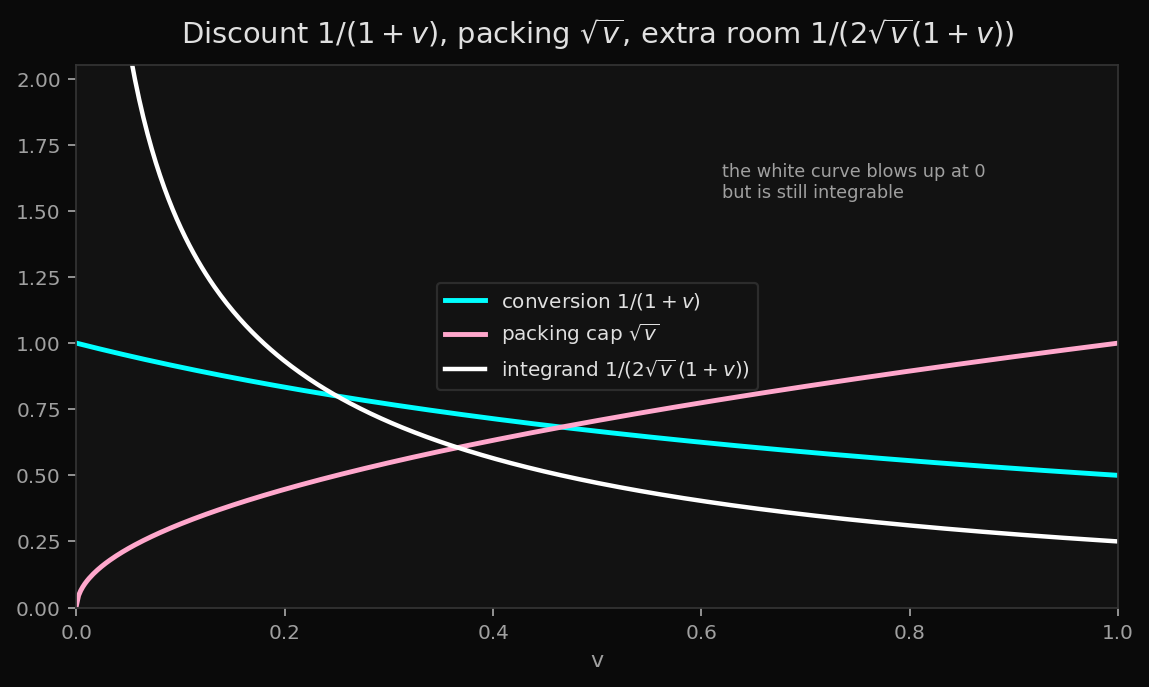
To bound the total $f$, split the composites into buckets by $v$, which is how the paper actually proceeds, and only then pass to an integral.
Pick a partition $0 = v_0 < v_1 < \cdots < v_k = 1$ of the interval $[0,1]$. Put in bucket $i$ those $a \in A_n$ with $v_i \le v(a) < v_{i+1}$. (Anything with $v(a) \ge 1$, i.e. $P(a)^2 \le a$, converts at rate $\le 1/2$ and can be lumped into the last bucket.) In bucket $i$,
\[f(\text{bucket } i) \;\le\; \frac{e^{\gamma}}{1+v_i} \cdot d(\text{that bucket's $L$-sets}),\]because every element there has conversion rate $\le 1/(1+v_i)$. Write $d_i$ for that bucket’s density. The packing constraint, applied to the union of the first $j$ buckets (the closer-to-prime elements), says
\[d_0 + d_1 + \cdots + d_{j-1} \;\le\; \sqrt{v_j}\, d(L_n).\]The rates $1/(1+v_i)$ are decreasing in $i$: small $v$ is the high-value real estate. Given a decreasing sequence of rates and upper bounds on the cumulative densities, the most $f$ you can extract is by filling each cumulative budget as soon as it opens — spend as much as you are allowed at the highest remaining rate.
A three-bucket cash register, before the symbols. Rates $1 \ge 0.8 \ge 0.5$, and you may spend at most density $0.5$ at the top rate, at most $0.7$ in the first two buckets combined, at most $1$ in all three. Fill high-rate first: $0.5$ at rate $1$, then the newly unlocked $0.2$ at rate $0.8$, then the remaining $0.3$ at rate $0.5$. Revenue $0.50+0.16+0.15=0.81$. Any other allocation is worse. That is the paper’s rearrangement lemma, in English.
Check yourself. Why is "any other allocation worse"? Try moving $0.1$ of density from bucket 1 to bucket 2.
Bucket 1 can't hold more than $0.5$, so the only moves are down: shift density from a higher-rate bucket to a lower-rate one. Moving $0.1$ from rate $0.8$ to rate $0.5$ loses $0.1\times(0.8-0.5)=0.03$. Every legal move trades a unit at a higher rate for a unit at a lower one. In general this is summation by parts: $\sum r_i d_i = \sum_j (r_{j-1}-r_j)\,D_j + r_{k-1}D_k$ with $D_j$ the cumulative sums, and every coefficient $r_{j-1}-r_j$ is $\ge 0$, so the sum is largest when every $D_j$ is as large as allowed.
The worst case is therefore $d_0 + \cdots + d_{j-1} = \sqrt{v_j}\, d(L_n)$, so the density of bucket $i$ is at most the newly unlocked packing room
\[\bigl(\sqrt{v_{i+1}} - \sqrt{v_i}\bigr)\, d(L_n).\]Hence
\[f(A_n) \;\le\; e^{\gamma}\, d(L_n) \sum_{i=0}^{k-1} \frac{\sqrt{v_{i+1}} - \sqrt{v_i}}{1+v_i}.\]This is a Riemann sum for an integral. Taking a finer and finer partition ($v_i = i/k$, then $k \to \infty$),
\[\sum_{i} \frac{\sqrt{v_{i+1}} - \sqrt{v_i}}{1+v_i} \;\longrightarrow\; \int_0^1 \frac{1}{1+v}\cdot \frac{d}{dv}\bigl[\sqrt{v}\bigr]\, dv \;=\; \int_0^1 \frac{dv}{2\sqrt{v}\,(1+v)}.\]The derivative of $\sqrt{v}$ is $\frac12 v^{-1/2} = 1/(2\sqrt{v})$: the extra packing room unlocked at level $v$ is $dv/(2\sqrt{v})$. Near $v=0$ the integrand blows up like $1/(2\sqrt{v})$, which is the white curve in the figure above. Do not panic: $\int_0^1 v^{-1/2}\,dv = 2$ is finite, so the singularity is integrable.
A coarse numerical check, four buckets, left endpoints:
| $v_i$ | $\sqrt{v_i}$ | $\sqrt{v_{i+1}}-\sqrt{v_i}$ | $1/(1+v_i)$ | product |
|---|---|---|---|---|
| $0$ | $0$ | $0.500$ | $1$ | $0.500$ |
| $0.25$ | $0.500$ | $0.207$ | $0.800$ | $0.166$ |
| $0.50$ | $0.707$ | $0.159$ | $0.667$ | $0.106$ |
| $0.75$ | $0.866$ | $0.134$ | $0.571$ | $0.076$ |
| sum | $0.848$ |
The sum $0.848$ is a coarse overestimate of $\pi/4 \approx 0.785$, as a left Riemann sum on a decreasing integrand should be. Finer partitions close the gap. Watch them close it, and flip the axis to see the substitution coming:
Each blue bar has area $(\sqrt{v_{i+1}}-\sqrt{v_i})/(1+v_i)$, bucket $i$'s worst-case contribution. On the $v$ axis the integrand $1/(2\sqrt v(1+v))$ blows up at $0$ (clipped here). On the $u=\sqrt v$ axis the same bars become a left Riemann sum for the tame curve $1/(1+u^2)$: the singularity was an artefact of the coordinate.
Now the integral, by substitution. Set $u = \sqrt{v}$, so $v = u^2$ and $dv = 2u\, du$. The limits stay $0$ to $1$, and the $2u$ in the numerator cancels the $2\sqrt{v}=2u$ in the denominator:
\[\int_0^1 \frac{dv}{2\sqrt{v}\,(1+v)} \;=\; \int_0^1 \frac{2u\, du}{2u\,(1+u^2)} \;=\; \int_0^1 \frac{du}{1+u^2}.\]The antiderivative of $1/(1+u^2)$ is $\arctan u$. (Chain rule: if $\theta = \arctan u$ then $u=\tan\theta$, $du/d\theta = \sec^2\theta = 1+\tan^2\theta = 1+u^2$.) And $\arctan 1 = \pi/4$, because that is the angle whose tangent is $1$: a $45^\circ$ angle, a quarter of a half-turn. Also $\arctan 0 = 0$. So
\[\boxed{\displaystyle \int_0^1 \frac{dv}{2\sqrt{v}\,(1+v)} \;=\; \frac{\pi}{4}}.\]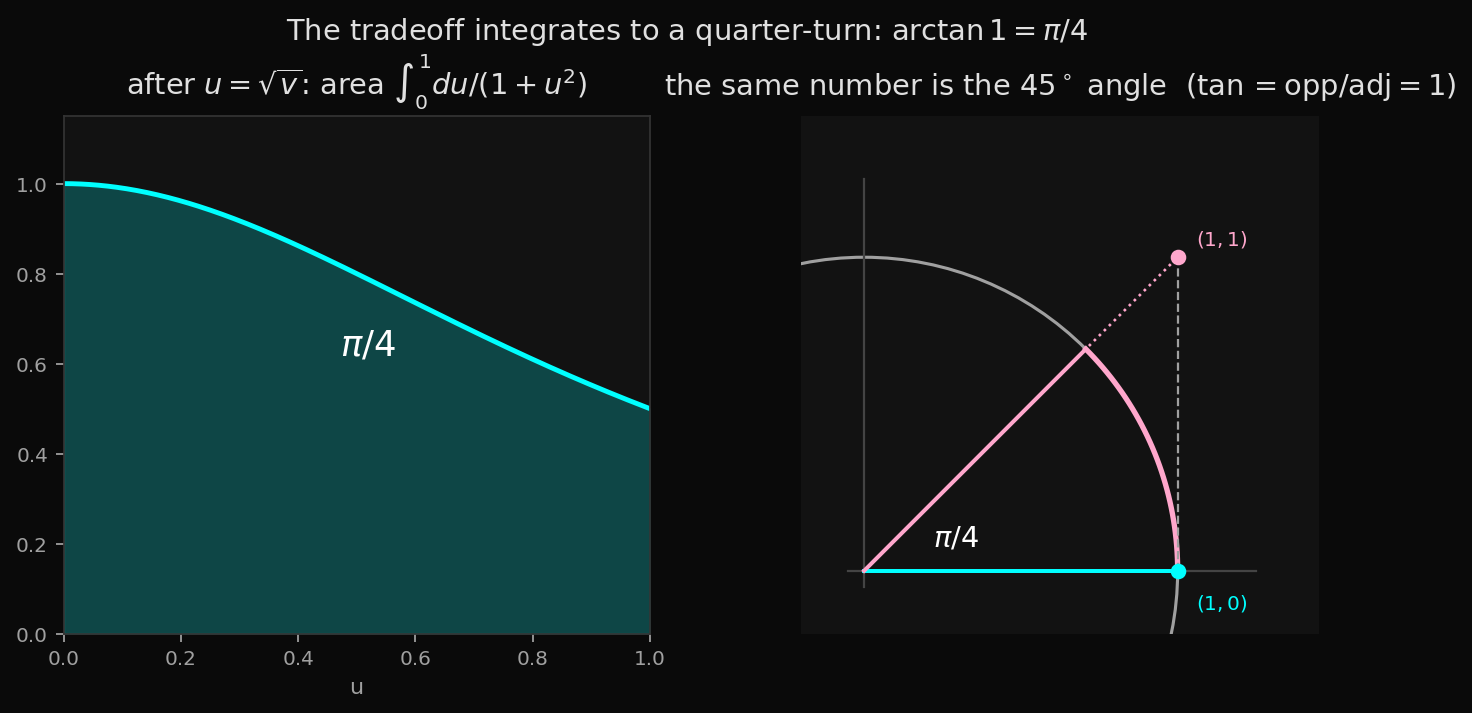
The left shaded region has area $\pi/4$. That same number is the angle on the right, in radians: $\mathrm{opp}/\mathrm{adj}=1/1=1$.
The factor $\pi/4 \approx 0.785$ is the proportion of a full-rate $e^{\gamma}$ that a slot of composites can realize under the $\sqrt{v}$ constraint. In the envelope, a slot $A_n$ of composites scores at most about
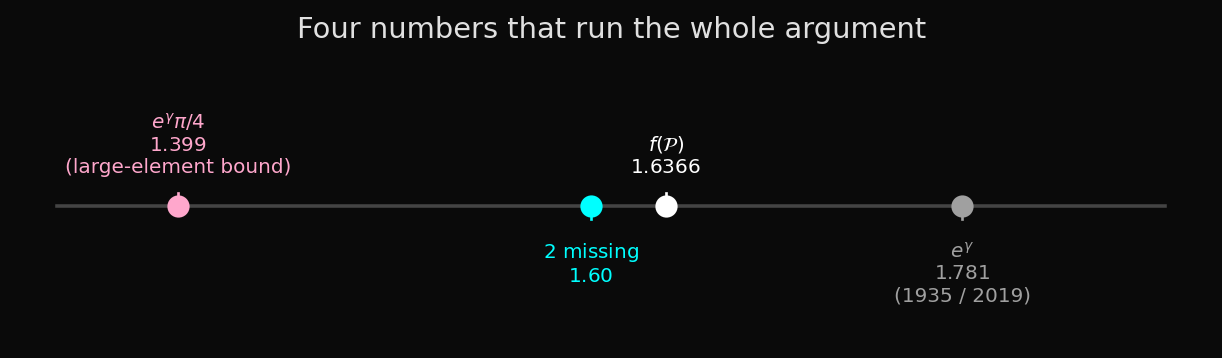
\[f(A_n) \;\le\; \frac{\pi}{4}\, e^{\gamma}\, d(L_n).\]That is the true output of the $\pi/4$ argument: a bound on a slot of composites, in terms of the density of the ambient territory $L_n$. It is not a global bound “$f(\text{all composites}) \le 1.399$.” (That global-looking number $e^{\gamma}\pi/4 \approx 1.399$ does appear, as an upper bound on $f(A)$ for primitive sets of large elements. That is a different theorem, about tails.)
odd primes beat their own composites
Specialize to $n = p$, an odd prime, with $p \notin A$. Then $A_p$ is a primitive set of composites all having smallest prime factor $p$, and the ambient territory is $L_p$, with
\[e^{\gamma}\, d(L_p) \;\approx\; f(p)\]by Mertens (this is the same comparison that produced $(\star)$ in Vol. IV). The $\pi/4$ bound becomes
\[f(A_p) \;\le\; \frac{\pi}{4}\cdot\bigl(1+\text{a small Mertens error}\bigr)\cdot f(p).\]The error is tracked in the paper with explicit bounds on Mertens’ product. The worst odd prime is $p = 3$, and even there the constant comes out strictly less than $0.901$. For larger odd primes it is better, and it tends to $\pi/4 \approx 0.785$ as $p \to \infty$. In all cases it is less than $1$:
Simply: you should never skip an odd prime in favour of composites with that smallest prime factor. Skipping $p$ and filling the slot with $3p$, $p^2$, products of larger primes, whatever primitive combination you like, returns less than $90\%$ of what $p$ itself was worth. (In the slot of an odd prime $p$ every element is odd, since its smallest prime factor is $p$.)
That is the true reason the primes win on the odd slots. The $\pi/4$ is a local comparison of composites to their parent prime, not a global score for “all the composites in $A$.” The $21\%$ of slack is what swallows the Mertens oscillation that killed $(\star)$ for infinitely many large primes.
If $p \in A$, then primitivity forbids any other multiple of $p$ from joining $A$, so $A_p = \lbrace p\rbrace$ and $f(A_p) = f(p)$ on the nose.
the prime $2$
Every odd prime is Erdős-strong. The remaining slot is $p = 2$.
If $2 \in A$, then $A$ contains no other even number. The odd part of $A$ is a primitive set of odd numbers, and the odd-prime theorem gives $f(A_p) \le f(p)$ for every odd $p$. Adding $f(2)$ back, $f(A) \le f(\mathcal{P})$.
If $2 \notin A$, the criterion $(\star)$ fails and the constants around $\pi/4$ do not quite prove that $2$ is Erdős-strong. The idea of the paper’s substitute is a $2$-power split. Every even $a$ factors as $2^k$ times an odd integer. The odd part lives in an odd slot, where we already win; the $2^k$ costs a factor $\sim 2^{-k}$ in the weight, so a pile of even composites is cheaper, in bulk, than $2$ itself. Tracking the possible $k$ and applying the odd-prime bounds to the odd parts produces a global estimate $f(A) < 1.60 < f(\mathcal{P})$. We will not replay the constants. The conjecture does not need $2$ to be Erdős-strong: when $2$ is missing, this direct bound already loses to the primes.
Whether $2$ itself is Erdős-strong — whether some primitive set of even numbers, none of which is $2$, can score more than $f(2) \approx 0.721$ in the even slot — was left open in 2022.
graph TD
    A["primitive set A"] --> B{"2 in A?"}
    B -->|"yes"| C["no other evens"]
    C --> D["odd slots: each A_p scores at most f(p)"]
    D --> E["f(A) ≤ f(P)"]
    B -->|"no"| F["π/4 on each odd slot, plus a 2-power split"]
    F --> G["f(A) < 1.60 < f(P)"]
    style E fill:#38bdf8,color:#000
    style G fill:#38bdf8,color:#000
the argument on one page
- Objects (Vol. I). A primitive set has no element dividing another. The primes are one; so are $\lbrace 6,10,15\rbrace$, every $(x,2x]$, and every $\lbrace\Omega = k\rbrace$. Counting and density cannot rank them.
- Ruler (Vol. II). $f(A)=\sum 1/(a\log a)$, on the knife-edge: infinite over all integers, $1.6366$ over the primes.
- Budget (Vol. III). Territories $L_a$ are disjoint for primitive $A$, so $\sum d(L_a)\le 1$. Mertens converts density to score at rate $e^\gamma$, giving $f(A)\lt e^\gamma = 1.781$.
- Slots and discount (Vol. IV). Compete prime by prime. A composite converts at the discounted rate $e^\gamma/(1+v)$, and nearly-prime composites can fill at most $\sqrt v$ of a slot.
- Quarter-turn (this volume). Discount against packing integrates to $\int_0^1 \frac{du}{1+u^2}=\pi/4$. Every odd prime beats its composites by nearly $10\%$. The prime $2$ is handled by a direct bound, $1.60 \lt 1.6366$.
The theorem says something simple enough to tell after one semester: among all the ways to pick integers so that none divides another, the primes are the heaviest, when each integer $a$ is weighed by $1/(a\log a)$. The reason, on a napkin, is local. In the slot of numbers with smallest prime factor $p$, a composite converts density at a discount $1/(1+v)$, the dangerous nearly-prime composites cannot spend more than density $\sqrt{v}$ of the slot, and the integral of that tradeoff is a quarter-circle. For every odd prime, that is strictly worse than taking $p$ itself.
what is still open
Is $2$ Erdős-strong? Lichtman proved every odd prime is. A negative answer would not have damaged the 2022 theorem — the case $2 \notin A$ is already lost to $f(\mathcal{P})$ by the global bound $1.60$ — but it would have meant that some primitive set of even numbers, none of which is $2$, scores more than $f(2) \approx 0.721$ in the even slot.
The Erdős–Sárközy–Szemerédi tail conjecture (1968). Restrict to primitive sets of large elements:
\[\lim_{x \to \infty} \sup_{\substack{A \subset [x,\infty)\\ A \text{ primitive}}} f(A) \;\stackrel{?}{\le}\; 1.\]This is where $e^{\gamma}\pi/4 \approx 1.399$ appears as a theorem: Lichtman’s method gives that upper bound on the lim-sup. The value $1$ is forced as a lower bound if the conjecture is true, because the set of integers with $\Omega(n) = k$ lives in $[2^k, \infty)$ and Lichtman had already proved that its Erdős sum tends to $1$ as $k \to \infty$.
A May 2026 preprint of Alexeev, Barreto, Li, Lichtman, Price, Shah, Tang, and Tao, arXiv:2605.00301, claims both that $2$ is Erdős-strong and that the tail conjecture is true, by a different method: a von Mangoldt-weighted Markov chain on the divisibility poset. It is marked preliminary. The 2022 $\pi/4$ argument remains the one this series unpacks.
Cheers.
further reading
Jared Duker Lichtman, A proof of the Erdős primitive set conjecture. Forum of Mathematics, Pi (2023). The paper. The envelope in this series is the argument of its introduction; the actual inequalities are in sections 2–4.
Boris Alexeev, Kevin Barreto, Yanyang Li, Jared Duker Lichtman, Liam Price, Jibran Iqbal Shah, Quanyu Tang, and Terence Tao, Primitive sets and von Mangoldt chains. May 2026 preprint. A different method, claiming the tail conjecture and that $2$ is Erdős-strong.
Jared Duker Lichtman, Almost primes and the Banks–Martin conjecture. Proves $f(\mathbb{N}_k) \to 1$.
Paul Erdős and András Sárközy, On the divisibility of sequences of integers. Source of the 1968 tail conjecture.
Tsz Ho Chan, Jared Duker Lichtman, and Carl Pomerance, On the critical exponent for $k$-primitive sets. Where $\tau = 1.1403\ldots$ comes from, and why the $t$-pointwise analogue of the conjecture fails.
Jared Duker Lichtman and Carl Pomerance, The Erdős conjecture for primitive sets. The $e^{\gamma}$ bound.
Hugh L. Montgomery and Robert C. Vaughan, Multiplicative Number Theory I: Classical Theory. Cambridge, 2007. Mertens’ theorems and the prime number theorem.
Quanta Magazine, Graduate Student’s Side Project Proves Prime Number Conjecture. The human story of the proof.
Primitive Sets: Vol. I · Vol. II · Vol. III · Vol. IV · Vol. V