Abel–Ruffini: I · II · III · IV · V · VI
Degrees multiply; radical steps are cyclic once roots of unity are present; subgroups mirror intermediate fields. Result: solvable by radicals $\iff$ solvable Galois group.
The tower theorem
Degrees multiply. That is the arithmetic of nested adjoining, and it is why a radical formula is a very particular kind of extension.
Theorem (tower law). If $K\subset L\subset M$ are fields, then
\[[M:K] = [M:L]\cdot[L:K].\]The product is ordinary multiplication when both factors are finite, and a product of cardinals otherwise. In particular, if $M/K$ is finite then so are both steps; if either step is infinite, so is $M/K$. This is the multiplicativity formula and the tower law.
Proof, finite case
Let $d=[L:K]$ and $e=[M:L]$, both finite. Choose a basis $\lbrace u_1,\ldots,u_d\rbrace$ of $L$ as a $K$-vector space, and a basis $\lbrace w_1,\ldots,w_e\rbrace$ of $M$ as an $L$-vector space. The claim is that the $de$ products $\lbrace u_m w_n\rbrace$ form a basis of $M$ over $K$.
They span. Take $x\in M$. Write $x=\sum_{n=1}^e a_n w_n$ with $a_n\in L$. Write each $a_n=\sum_{m=1}^d b_{m,n} u_m$ with $b_{m,n}\in K$. Then
\[x = \sum_{n=1}^e\sum_{m=1}^d b_{m,n}\,(u_m w_n).\]They are linearly independent. Suppose $\sum_{n,m} b_{m,n}(u_m w_n)=0$ with $b_{m,n}\in K$. Group as $\sum_n \bigl(\sum_m b_{m,n} u_m\bigr) w_n = 0$. Linear independence of the $w_n$ over $L$ forces $\sum_m b_{m,n} u_m = 0$ for each $n$. Linear independence of the $u_m$ over $K$ forces every $b_{m,n}=0$.
Hence $[M:K]=de$.
(The infinite case is the same argument with bases indexed by sets $A$ and $B$; the product basis is indexed by $A\times B$.)
What the formula forbids
If $[M:K]$ is prime, there is no field strictly between $K$ and $M$: the only factorizations of a prime are $1\cdot p$ and $p\cdot 1$. You cannot break the extension into smaller steps. That is why a prime-length cycle in a Galois group is powerful — under the correspondence it is an indivisible layer. Thus $\mathbb{C}/\mathbb{R}$, of degree $2$, has no intermediate field, and $\mathbb{Q}(\sqrt{2})/\mathbb{Q}$ has none either.
**Worked tower: $\mathbb{Q}(\sqrt{2},\sqrt{3})$. ** Let $L=\mathbb{Q}(\sqrt{2})$, so $[L:\mathbb{Q}]=2$. The polynomial $x^2-3$ remains irreducible over $L$ (if $\sqrt{3}=a+b\sqrt{2}$ then squaring and comparing rational and irrational parts yields a contradiction). So $[L(\sqrt{3}):L]=2$, hence $[\mathbb{Q}(\sqrt{2},\sqrt{3}):\mathbb{Q}]=4$. A basis is $\lbrace 1,\sqrt{2},\sqrt{3},\sqrt{6}\rbrace$. This is a radical tower of two square-root steps, total degree $2\cdot 2=4$.
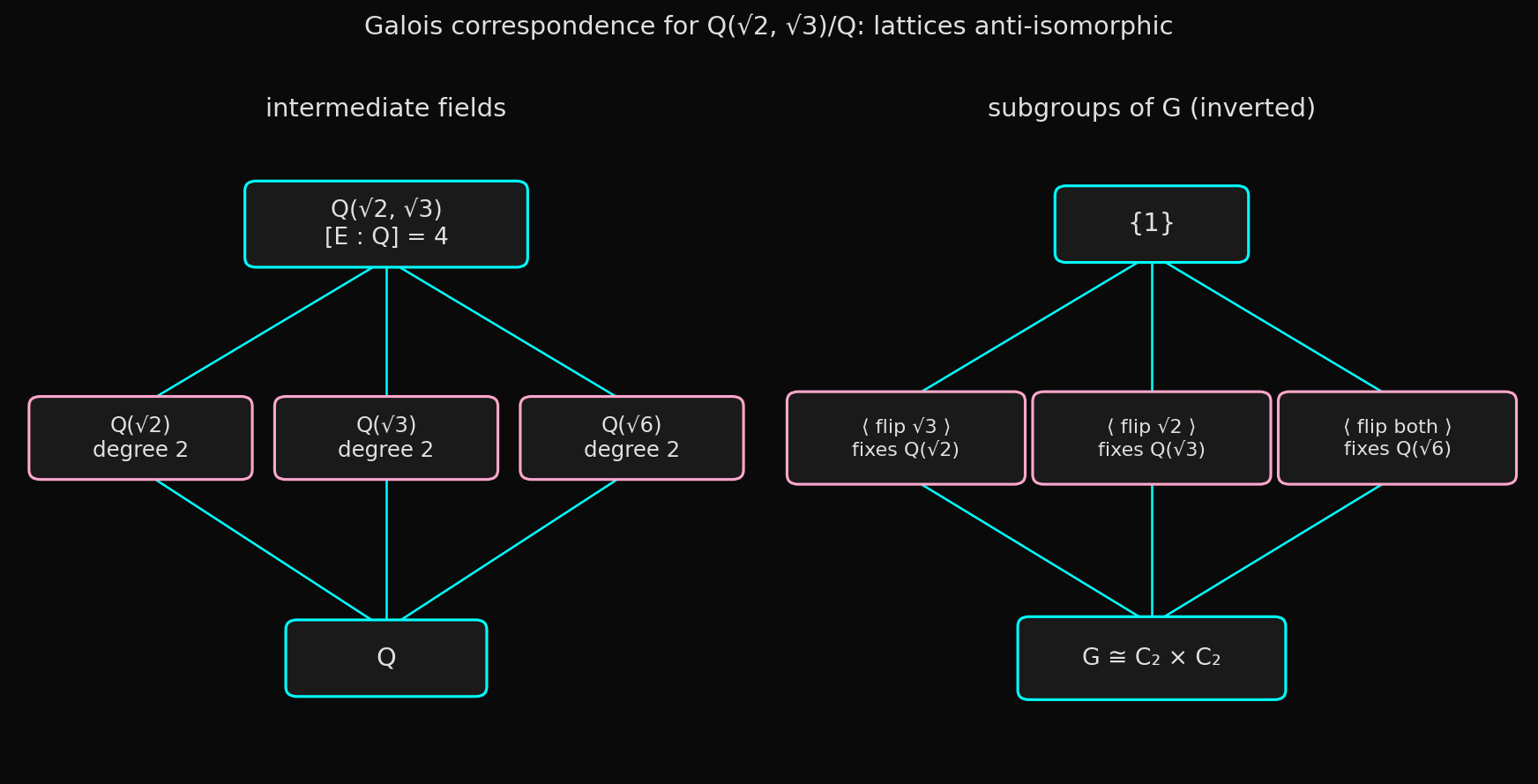
The same tower law reads the intermediate fields. Any proper subfield of a degree-$4$ extension has degree $2$ over $\mathbb{Q}$. There are three of them: $\mathbb{Q}(\sqrt{2})$, $\mathbb{Q}(\sqrt{3})$, and $\mathbb{Q}(\sqrt{6})$. Each is the fixed field of a subgroup of order $2$ in the Klein four-group $\mathrm{Gal}(\mathbb{Q}(\sqrt{2},\sqrt{3})/\mathbb{Q})\cong C_2\times C_2$, generated by the independent sign-flips $\sqrt{2}\mapsto\pm\sqrt{2}$ and $\sqrt{3}\mapsto\pm\sqrt{3}$. Nested square roots, in this instance, produce an abelian Galois group of exponent $2$ — as solvable as a group can be.
A nested radical need not denest. $\sqrt{2+\sqrt{2}}$ generates a degree-$4$ extension of $\mathbb{Q}$ (its minimal polynomial is $x^4-4x^2+2$), sitting in the radical tower $\mathbb{Q}\subset\mathbb{Q}(\sqrt{2})\subset\mathbb{Q}(\sqrt{2+\sqrt{2}})$. Eisenstein’s criterion, used here and below: if a prime $q$ divides every coefficient of a monic $f\in\mathbb{Z}[x]$ except the leading $1$, and $q^2$ does not divide the constant term, then $f$ is irreducible over $\mathbb{Q}$. For $x^4-4x^2+2$ take $q=2$. Sometimes nested expressions collapse — $\sqrt{5+2\sqrt{6}}=\sqrt{2}+\sqrt{3}$ — and the tower law is how you prove the collapse: both sides generate the same degree-$4$ field. When they do not collapse, you are genuinely climbing. A prime-degree step has no room for an intermediate field, which is why a cyclic prime-degree radical extension cannot be “partially denested.”
Radical towers, measured
A radical formula builds numbers one controlled extraction at a time. Once the necessary roots of unity are available, the different choices for one extraction differ cyclically: for a square root, just a sign; for a cube root, multiplication by $1,\omega,\omega^2$. Thus radical constructions can only build root symmetries in successive commutative layers. “Solvable group” is the name for exactly that layered structure. The next two paragraphs confirm the claim rather than introduce it cold.
A pure radical step $F(\sqrt[n]{a})/F$ has degree dividing $n$: the minimal polynomial of $\sqrt[n]{a}$ over $F$ divides $x^n-a$. Once the $n$th roots of unity already live in $F$, the extension (if irreducible) is cyclic of degree $n$, with Galois group generated by $\sqrt[n]{a}\mapsto \zeta_n\sqrt[n]{a}$. That is Kummer theory: adjoining an $n$th root, in the presence of the $n$th roots of unity, is a cyclic Galois extension. Plainly: after adjoining those roots of unity, choosing an $n$th root differs only by multiplying by one of them, so that step has cyclic symmetry.
A nested-radical formula is therefore a tower whose successive Galois groups — after one inserts the missing roots of unity, so that each step splits $x^{n_i}-a_i$ completely — are cyclic. The composite Galois group, by the correspondence below, is assembled from cyclic quotients: it is solvable.
The insertion of roots of unity is not a minor bookkeeping point. A radical $\sqrt[n]{a}$ has $n$ conjugates, the other $n$th roots of $a$, and they differ by $n$th roots of unity. If those roots of unity are not already in the current field, the pure-radical step $F(\sqrt[n]{a})/F$ is typically not Galois (the real cube root of $2$, again). The refined tower that Galois theory wants looks like
\[F \subset F(\zeta_{n_1}) \subset F(\zeta_{n_1},\sqrt[n_1]{a_1}) \subset \cdots,\]each step Galois, first abelian (cyclotomic), then cyclic (Kummer). Cyclotomic extensions are themselves solvable — $\mathrm{Gal}(\mathbb{Q}(\zeta_n)/\mathbb{Q})\cong(\mathbb{Z}/n\mathbb{Z})^\times$ is abelian — so inserting them does not smuggle in non-solvable symmetry. It merely makes the correspondence apply at every rung.
The Galois correspondence, exhibited on a small example
Galois correspondence. Subgroups of $\mathrm{Gal}(E/F)$ $\leftrightarrow$ intermediate fields, inclusion-reversed. Normal subgroups $\leftrightarrow$ Galois subextensions. Degrees match orders.
Let $E/F$ be finite Galois, $G=\mathrm{Gal}(E/F)$. There is an inclusion-reversing bijection
\[\{\text{subgroups }H\le G\} \;\longleftrightarrow\; \{\text{fields }K\text{ with }F\subset K\subset E\}\]sending $H$ to its fixed field $E^H$ and sending $K$ to $\mathrm{Gal}(E/K)$. Degrees match orders: $[E:E^H]=\lvert H\rvert$ and $[E^H:F]=[G:H]$. Moreover $K/F$ is Galois if and only if $\mathrm{Gal}(E/K)$ is normal in $G$, in which case $\mathrm{Gal}(K/F)\cong G/\mathrm{Gal}(E/K)$.
This is the dictionary between the group theory of Vol. III and the towers of this volume. For $\mathbb{Q}(\sqrt{2},\sqrt{3})$ it is the picture already drawn by the tower law: three intermediate fields of degree $2$, three subgroups of order $2$, lattices inverted.
A chain of fields $F=F_0\subset F_1\subset\cdots\subset F_k=E$ with each $F_{i+1}/F_i$ Galois cyclic corresponds to a chain of groups $G=\mathrm{Gal}(E/F_0)\trianglerighteq \mathrm{Gal}(E/F_1)\trianglerighteq\cdots\trianglerighteq\lbrace 1\rbrace$ with cyclic quotients. That is a solvable series.
Theorem (Galois; used as a standard criterion, sketch only). A separable polynomial $f\in F[x]$ is solvable by radicals over $F$ if and only if $\mathrm{Gal}(f/F)$ is a solvable group.
This is the heart of Abel–Ruffini, and a complete proof is a chapter of a Galois-theory book. What follows is the shape of the argument, not a substitute for that chapter.
Sketch, radicals $\Rightarrow$ solvable group. A radical expression determines a radical tower. Insert roots of unity so that each step splits some $x^{n_i}-a_i$ (the cyclotomic extension $\mathbb{Q}(\zeta_n)/\mathbb{Q}$ has abelian Galois group $(\mathbb{Z}/n\mathbb{Z})^\times$, hence is itself solvable, and inserts no extra obstruction). Each refined step is cyclic Galois by Kummer. The correspondence turns the field tower into a chain of cyclic quotients. The Galois group of the splitting field is therefore solvable.
Sketch, solvable group $\Rightarrow$ radicals. If $\mathrm{Gal}(E/F)$ is solvable, refine the series to cyclic quotients of prime order. After a cyclotomic base change, Kummer realizes each cyclic step as a pure radical extension. The roots then lie in a radical tower.
Ruffini assumed the radicals in a putative formula already lived inside the splitting field. That is extra. Cardano’s formula for $x^3-15x-20$ extracts cube roots of $10\pm 5i$, which do not lie in the splitting field over $\mathbb{Q}$ (the three roots are real). Abel’s theorem on natural irrationalities repairs the general-coefficient case; Galois’ criterion repairs all cases.
We now have the two halves. A radical formula $\Rightarrow$ solvable Galois group. $S_n$ for $n\ge 5$ is not solvable. It remains to see that the general quintic — and some perfectly concrete quintics over $\mathbb{Q}$ — actually have Galois group $S_5$. That is the symmetry of the quintic.
Next: Vol. VI: Quintic Symmetry
Abel–Ruffini: Vol. I · Vol. II · Vol. III · Vol. IV · Vol. V · Vol. VI