Sphere Eversion: I · II · III · IV · V · VI
A zero-to-hero guide to one theorem: a sphere can be turned inside out, smoothly, if it is allowed to pass through itself. We start with the definition of an open set.
In May 2024 I asked a small language model, running locally, to talk me through Smale’s theorem that any two immersions of $S^2$ in $\mathbb{R}^3$ are regularly homotopic. The transcript is Sphere Eversion Phi3 Notes I. The questions were the right questions. The proofs were not: a linear interpolation was offered as a regular homotopy, the hairy-ball theorem was credited to Smale, and $S^2\times[0,1]$ was described as a solid ball.
In September 2024 I wrote a straight exposition under the title The Eversion of the Sphere. It had the theorem right and the pictures wrong. The interactive “eversion” flattened $z$ through zero — exactly the crease the text forbade — and the “Morin surface” was an unnamed polynomial that did not match any formula on the page. That draft is folded into this series; the old URL redirects here.
This series is the two of them talking, rebuilt from the ground up. Whenever the Phi-3 transcript asked a good question, it appears as a boxed Student question, answered by the Teacher. Everything else is built from definitions. Every figure is an equation you can drag.
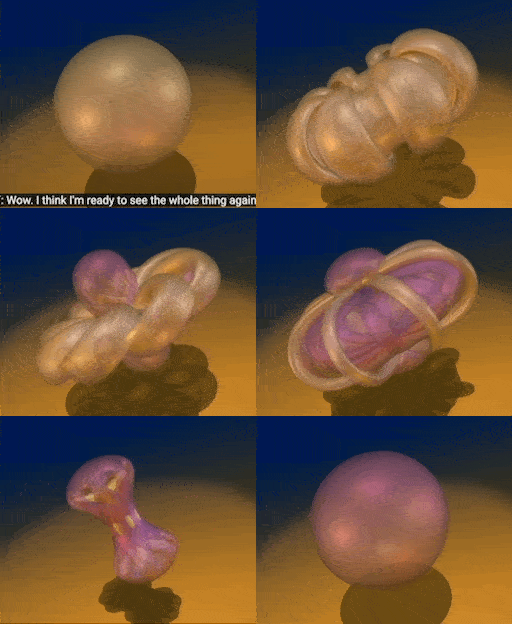
The still above is a genuine eversion, passing through Morin’s halfway model. By the end of Vol. VI you will know exactly what it is a picture of, and why its existence was proved before anyone could draw it.
| Vol. | Topic | What it contributes to the proof |
|---|---|---|
| I | Open, closed, clopen | Spaces, continuity, connectedness: the reason an integer that varies continuously cannot jump. |
| II | Paths and homotopy | Homotopy, $\pi_{1}(S^1)=\mathbb{Z}$, and $\pi_{k}(S^n)=0$ for $k<n$. |
| III | Manifolds and immersions | Charts, the Jacobian, immersions, regular homotopy, and a homotopy that cheats. |
| IV | Curves in the plane | Turning number and Whitney–Graustein: why a circle cannot evert. |
| V | Frames and Smale's theorem | Fibrations, $SO(3)\cong\mathbb{RP}^3$, the belt trick, and $\pi_{2}(V_{3,2})=0$. |
| VI | Seeing the eversion | Corrugations, a ruled formula for the halfway model, and how to tell you are halfway. |
the question
Here is the target, stated once in full so that every word can be earned later. Let $\iota(p)=p$ be the standard sphere and $\alpha(p)=-p$ its antipodal copy, whose inside faces out.
“Immersion” is Vol. III. This volume is about the words space and path-connected.
open balls and open sets
Distance in $\mathbb{R}^n$ is $d(p,q)=\lVert p-q\rVert$. The open ball of radius $\varepsilon>0$ about $p$ is
\[B(p,\varepsilon)=\{\,q\in\mathbb{R}^n:\ d(p,q)<\varepsilon\,\}.\]Open means every point has room. The open disk $\lbrace\lVert p\rVert<1\rbrace$ is open: a point at distance $d<1$ from the centre can use $\varepsilon=1-d$. The closed disk $\lbrace\lVert p\rVert\le 1\rbrace$ is not: a point on the edge belongs to the set, but every ball around it pokes outside.
Equivalently, $C$ is closed when it contains every point it can get arbitrarily close to (its limit points). Closed is not the opposite of open. A set can be both, or neither. Try all three:
Solid edge: those points belong to the set. Dashed edge: they do not. The gold disk is the biggest ball around your point that stays on one side. On the edge no ball works, and which side fails decides whether the set is open, closed, or neither.
The half-open disk is neither: its top edge has points in the set with no room (so it is not open), and its bottom edge has points outside the set with no room in the complement (so it is not closed). On the real line the same thing happens with $[0,1)$.
Two facts about open sets in $\mathbb{R}^n$ are worth checking by hand, because they become the definition of everything else:
- Any union of open sets is open. If $p$ lies in the union it lies in one of the sets, and that set’s ball works.
- A finite intersection of open sets is open. If $p\in U_{1}\cap\dots\cap U_{k}$, take the smallest of the $k$ radii. With infinitely many sets the smallest radius may be $0$: $\bigcap_{n}(-\tfrac1n,\tfrac1n)=\lbrace 0\rbrace$, which is not open.
topologies
Those two facts, plus “$\varnothing$ and the whole space are open”, are all we ever use. So we promote them to a definition and forget the distance.
Examples that will matter:
- Metric topologies. Any set with a distance function, open sets defined by balls exactly as above. This includes $\mathbb{R}^n$, the sphere $S^2$ (with distance measured in $\mathbb{R}^3$), and, crucially, spaces of maps. For maps $f,g:S^2\to\mathbb{R}^3$ with derivatives, $d(f,g)=\sup\lVert f-g\rVert+\sup\lVert df-dg\rVert$ is a distance. Two surfaces are close when their points and their tangent planes are close. That is the topology in which Smale’s theorem lives.
- The discrete topology. Every subset is open. On $\mathbb{Z}$ with its usual distance this is what you get, since $B(n,\tfrac12)=\lbrace n\rbrace$.
- The subspace topology. If $Y\subseteq X$, a set is open in $Y$ when it is $U\cap Y$ for some $U$ open in $X$. Open-ness is relative to the ambient space, and this is where things get interesting.
clopen sets and connectedness
Theorem. The interval $[0,1]$ is connected.
Proof. Suppose $A\subseteq[0,1]$ is clopen and contains $0$; we show $A=[0,1]$. Let $s=\sup\lbrace x: [0,x]\subseteq A\rbrace$. Because $A$ is closed, it contains the limit point $s$. Because $A$ is open (in $[0,1]$), if $s<1$ some interval $[s,s+\varepsilon)$ also lies in $A$, contradicting the choice of $s$. So $s=1$ and $A=[0,1]$. If instead $0\notin A$, apply the argument to the complement, which is also clopen. $\square$
This is the completeness of the real numbers, wearing a topological hat. It is the single fact on which the rest of the series leans.
continuity
In calculus, $f$ is continuous if for every $\varepsilon$ there is a $\delta$. In topology the same idea is one line.
For $f:\mathbb{R}\to\mathbb{R}$ this is exactly $\varepsilon$–$\delta$: take $V=(f(x)-\varepsilon,\,f(x)+\varepsilon)$; “the preimage is open” says some $(x-\delta,\,x+\delta)$ maps into $V$. Drag the interval below and try to find an open $V$ whose preimage is not open.
Hollow dot: endpoint not included. Filled dot: endpoint included. For the continuous function every preimage is a union of open intervals, wherever you put $V$. For the step function one position of $V$ produces a preimage with a filled endpoint, a point with no room, and that single failure is the discontinuity.
Now the payoff, in three lines.
Theorem. The continuous image of a connected space is connected.
Proof. If $f:X\to Y$ is continuous and onto and $B\subseteq Y$ is clopen, then $f^{-1}(B)$ is clopen in $X$ (preimages respect complements). If $X$ is connected, $f^{-1}(B)$ is $\varnothing$ or $X$, so $B$ is $\varnothing$ or $Y$. $\square$
Corollary (intermediate value theorem). A continuous $f:[0,1]\to\mathbb{R}$ takes every value between $f(0)$ and $f(1)$. (Otherwise a missed value $c$ splits the image into the clopen pieces below and above $c$.)
Corollary (integers cannot jump). Every continuous map from a connected space to $\mathbb{Z}$ is constant. $\mathbb{Z}$ is discrete, so each $\lbrace n\rbrace$ is clopen, and a connected image must be one point.
That last corollary is the engine of the whole subject. In Vol. II the integer is a winding number. In Vol. IV it is the turning number of a curve, and it proves a circle cannot be turned inside out in the plane. In Vol. V the integer is replaced by an element of a group, and the group turns out to be zero.
paths and path-connectedness
Path-connected spaces are connected: a clopen split of $X$ would pull back, along a path joining the two pieces, to a clopen split of $[0,1]$. The converse fails for exotic spaces (the topologist’s sine curve), but not for anything in this series: for locally path-connected spaces, which include manifolds and the spaces of maps we care about, connected and path-connected agree.
The path components of $X$ are its maximal path-connected pieces; the set of them is written $\pi_{0}(X)$. Now the theorem can be restated with no vague words left except “immersion”:
\[\text{Smale:}\qquad \pi_0\bigl(\operatorname{Imm}(S^2,\mathbb{R}^3)\bigr)=\{\ast\}.\]A point of this space is an entire immersed sphere. A path in it is a movie of immersed spheres, each close to the next in both position and tangent planes. An eversion is a path from $\iota$ to $\alpha$.
compactness, and why immersions have room
One more word, because we will use it once in a crucial place.
$S^2$ is closed and bounded, so compact. The fact we need is: a continuous real function on a compact space attains its minimum. Apply it to an immersion $f$, whose tangent vectors $f_{u},f_{v}$ are independent everywhere, so $m=\min\lVert f_{u}\times f_{v}\rVert>0$. The cross product is continuous in the derivatives, so any map $g$ whose derivatives are uniformly close enough to $f$’s (how close depends only on $m$ and on the size of $df$) still has $\lVert g_{u}\times g_{v}\rVert>0$. So every immersion has a ball of immersions around it:
\[\operatorname{Imm}(S^2,\mathbb{R}^3)\ \text{is an open subset of}\ C^1(S^2,\mathbb{R}^3).\]On a non-compact surface the minimum could be $0$ at infinity and there would be no room. On the sphere there always is. This is the fact that makes wiggling an immersion safe, and wiggling is how every eversion is built.
(The last axiom we need is Hausdorff: distinct points have disjoint open neighbourhoods, so limits are unique. Every metric space is Hausdorff. It shows up in the definition of a manifold in Vol. III and nowhere else.)
where this goes
We now have the language to ask the question. $\operatorname{Imm}(S^2,\mathbb{R}^3)$ is a topological space. Its path components are what we want to count. The tool for counting path components of spaces of maps is homotopy, and the first thing it counts is how many times a loop winds around a hole.
Next: Vol. II: Paths and Homotopy
Sphere Eversion: Vol. I · Vol. II · Vol. III · Vol. IV · Vol. V · Vol. VI