Sphere Eversion: I · II · III · IV · V · VI
The existence proof is done. This volume is about seeing it: slack, a formula you can type, and an honest way to say “halfway”.
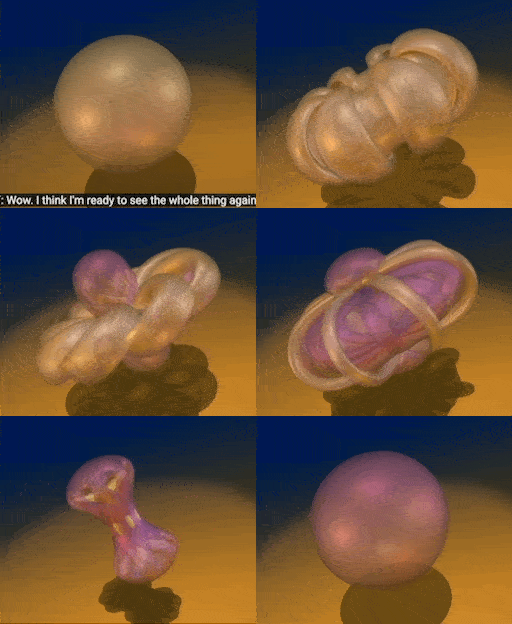
Vol. V proved that $\iota(p)=p$ and $\alpha(p)=-p$ lie in the same path-component of $\operatorname{Imm}(S^2,\mathbb{R}^3)$. It did not produce a path. Nobody could picture one at first. The first explicit eversions came from Arnold Shapiro (published by Tony Phillips, 1966) and Bernard Morin (late 1960s), who was blind. Here are three windows onto what they saw.
slack that does not crease
The amplitude $\varepsilon\sin\theta$ dies at the poles, so the chart singularities of $\mathbf{r}$ stay chart singularities. For $\lvert\varepsilon\rvert<1$ the radial factor never vanishes, and a computation of $\mathbf{f}_{\theta}\times\mathbf{f}_{\varphi}$ shows that its component along $\mathbf{r}$ is $\rho^2\sin\theta$ with $\rho=1+\varepsilon\sin\theta\sin(k\varphi)>0$, while the ripple only adds tangential terms — so it is never zero away from the chart poles. This is an immersion for every $\varepsilon$ in that range (an embedding, even: each ray from the origin meets it once). It is not an eversion. It is the ingredient that makes an eversion possible: extra wiggles so that later, when you try to pass sheets through each other, you have room.
The September 2024 draft (see Vol. I) implemented “corrugation” and then multiplied $z$ by a factor passing through zero. That second step is $F_{s}$ again. Here there is no second step. The two colours are the two sides of the surface. Drag both sliders as far as they go: the colours never trade places, and $\min\rho$ stays positive.
$\mathbf{f}_{\varepsilon}=(1+\varepsilon\sin\theta\sin(k\varphi))\,\hat{\mathbf{r}}$. Blue is the outside, orange the inside. Increase $\varepsilon$: petals, no fold. This is slack, not eversion.
a formula that actually everts a band
Existence is not a picture. Morin gave the first explicit halfway model — a four-lobed immersion with a single quadruple point — and later Apéry wrote algebraic formulae. A family you can type into a shader is due to Adam and Witold Bednorz, Analytic sphere eversion using ruled surfaces, arXiv:1711.10466. They evert a cylinder (the sphere minus two polar caps) by a ruled surface, then close the caps by a damped inversion. We draw only the cylinder, so that every vertex is the displayed equation.
\[\begin{aligned} x&= t\cos\varphi + p\sin\bigl((n-1)\varphi\bigr) - h\sin\varphi,\\ y&= t\sin\varphi + p\cos\bigl((n-1)\varphi\bigr) + h\cos\varphi,\\ z&= h\sin(n\varphi) - \frac{t}{n}\cos(n\varphi) - q\,t\,h. \end{aligned}\]Parameters: $n=2$ (Morin band) or $n=3$ (Boy band), $q=\tfrac23$, and $p=1-\lvert qt\rvert$, which is exactly the choice that keeps their smoothness inequality
\[(n-1)p\bigl(1-q\lvert t\rvert\bigr)+qt^2>0.\]The coordinates are $(\varphi,h)\in S^1\times\mathbb{R}$. At $t=0$, $n=2$ this is the ruled halfway model: four sheets through the origin (the quadruple point $Q$), and no preferred side. Sliding $t$ from $-3/2$ to $3/2$ swaps the two rims of the cylinder. That swap, once the poles are sewn back on, is the eversion of the band.
Equation (4) of Bednorz–Bednorz, $q=2/3$, $p=1-\lvert qt\rvert$, $h\in[-2.3,2.3]$. The poles are not closed; what you see is the formula, not a screenshot of Outside In. At $t=0$, $n=2$ you are looking at the ruled Morin halfway. At $n=3$, $t=0$ you are looking at a ruled Boy surface, an immersion of $\mathbb{RP}^2$.
To finish the sphere one maps $h=\omega\sin\theta/\cos^n\theta$ and applies Bednorz’s damped inversion (their (7)–(8)). That is a page of algebra and a second rendering pass. The point of this canvas is narrower: a halfway model you can audit against a paper.
a volume that must cross zero
For the illegal homotopy $F_{s}$ the integrand is one line: $F_{s}\cdot(\mathbf{F}_{\theta}\times\mathbf{F}_{\varphi})=(1-2s)\sin\theta$, so
\[V(F_s)=(1-2s)\,\frac{4\pi}{3}.\]It crosses zero at $s=\tfrac12$, which is exactly where $F_{s}$ creases: the cheap way to reach zero volume is to flatten. A genuine eversion must also pass through $V=0$, but with a surface that is still immersed, its self-intersections arranged so that positive and negative volume cancel.
A correction. An earlier version of this page measured “halfway” by the alignment of normals, $S(s)=\int_{S^2}\mathbf{n}_{0}\cdot\mathbf{n}_{s}\,dA$, and claimed $S$ runs from $4\pi$ to $-4\pi$ along an eversion. It does not. The normal is computed from the pushed frame, and $d\alpha=-I$ flips both frame vectors, so $\mathbf{n}_{\alpha}(p)=\mathbf{n}_{\iota}(p)=p$ and $S=+4\pi$ at the end. What changes under eversion is not the normal but its relation to the position: at $\alpha(p)=-p$ the normal $p$ points inward. Signed volume sees that; normal alignment does not. Both are plotted below for $F_{s}$, with $\alpha$’s values marked.
Both curves are computed live by a trapezoid rule on the integrands in the text, for the crease homotopy $F_{s}$. The hollow markers at $s=1$ are the values for the true everted sphere $\alpha(p)=-p$: signed volume $-1$, but normal alignment $+1$. The orange band is $s=\tfrac12$, where $F_{s}$ is not an immersion.
what the model got wrong
The May transcript is still worth reading. It is a record of the questions one actually asks. Here is the answer key.
| Claim in the Phi-3 notes | Fact |
|---|---|
| $H=(1-t)f_{0}+tf_{1}$ is a regular homotopy. | It is a homotopy of maps. Rank drops. See $F_{s}$. |
| $\partial_{\theta}(1,0,0)=\mathbf{0}$. | Differentiate the chart, not the point. $\mathbf{r}_{\theta}(1,0,0)=(0,0,-1)$. |
| Jacobian of $f:\mathbb{R}^n\to\mathbb{R}^m$ is $n\times m$. | $m\times n$. For immersions $S^2\to\mathbb{R}^3$ it is $3\times 2$; there is no determinant. |
| $\det J=-1$ means a saddle. | It means orientation reversal. A saddle is a critical point, which requires $\det J=0$ (in the square case). |
| $S^2\times[0,1]$ is a ball. | It is a spherical shell. The ball is $D^3$. |
| Smale's hairy ball theorem. | Poincaré–Brouwer. Smale classified immersions of $S^2$. |
| Thurston's magic formula ($J(g_{t})>0$) proves eversion. | Smale proved existence. Thurston gave corrugations. Bednorz wrote a ruled family. |
| Eversion forbids self-intersection and uses contact / Reeb foliations. | Self-intersection is the point. Contact geometry is a different chapter. |
| The complex exponential at $(0,\pi/2)$ has $\det J=-1$. | $\det J=e^{2x}=1$ there. The map is a local diffeomorphism everywhere. |
the arc
Topology gives the grammar: open sets, continuity, connectedness, homotopy (Vols. I–II). Calculus gives the language: charts, $J_{f}$, $\mathbf{f}_{u}\times\mathbf{f}_{v}\neq\mathbf{0}$. Function spaces give the question: is $\operatorname{Imm}(S^2,\mathbb{R}^3)$ path-connected? Circles in the plane say no, by $\pi_{1}(S^1)=\mathbb{Z}$. One dimension up, the same instinct produces $\pi_{2}(V_{3,2})$, and that group is zero. Smale’s theorem is that computation plus a fibration argument. Morin, Thurston, and Bednorz are what you do if you want to see a path.
The May 2024 transcript asked. The September 2024 draft answered, and then drew the forbidden crease. These six volumes circle the sphere, starting from the definition of an open set, until the picture and the equation are the same object.
Further reading. S. Smale, A classification of immersions of the two-sphere, Trans. Amer. Math. Soc. 90 (1958). A. Bednorz and W. Bednorz, arXiv:1711.10466. S. Levy, D. Maxwell, T. Munzner, Outside In, Geometry Center, 1994. Guillemin–Pollack, Differential Topology. J. Munkres, Topology. A. Hatcher, Algebraic Topology (free online). M. Hirsch, Immersions of manifolds, Trans. AMS 93 (1959). H. Whitney, On regular closed curves in the plane, Compositio Math. 4 (1937). The raw parent transcript: Phi-3 notes.
Sphere Eversion: Vol. I · Vol. II · Vol. III · Vol. IV · Vol. V · Vol. VI